
Ignition and flame faults
A unit that tries to fire and fails, or fires and cuts out, usually has an ignition or flame-sensing fault. The error code narrows it down, and the fix is a part, not a new unit.
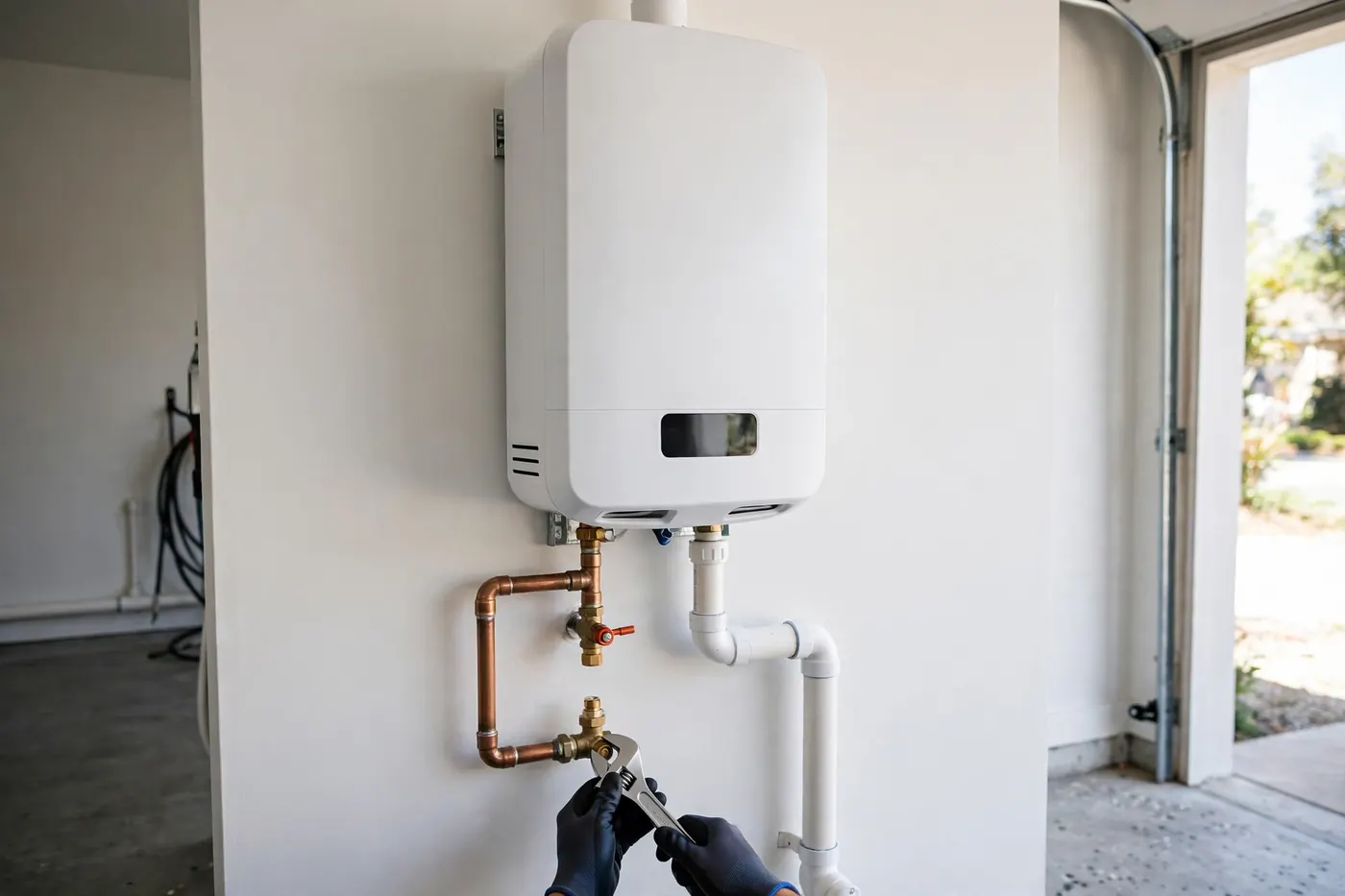
A tankless water heater that fluctuates, flashes an error code or gives low flow is usually telling you one thing in Seagoville: scale. The city's tap water runs at about 9.5 grains per gallon, and a tankless heat exchanger is the narrowest passage that hard water flows through. Most tankless faults are diagnosed in one visit, and descaling fixes the most common of them.
Open Mon-Fri, 7am-6pm
Call (833) 382-2711 for tankless water heater repair anywhere in Seagoville, TX. In Seagoville hard water, scale buildup is the most common cause of fluctuating temperature, error codes and low flow, and a descaling service usually fixes it. Note the error code on the display before you call.
A tankless unit that has never been descaled in hard water can fail years early. Annual descaling is the maintenance that keeps a 20 year unit on track. See water heater maintenance in Seagoville for the yearly plan.
Every tankless fault starts with a symptom and, often, a code on the display. This table lists the common symptoms, the usual causes and the safe checks to do yourself before you call. Error codes vary by brand and model, so the code plus the symptom is what the technician needs.
| Symptom | Likely cause | First check |
|---|---|---|
| Temperature goes hot then cold | Scale in the heat exchanger, flow too high for the unit | Note whether it happens when two fixtures run at once. |
| Error code on the display | Ignition failure, venting blockage, scale, sensor fault | Write down the code exactly as it appears. |
| Low hot water flow | Scale buildup, blocked inlet filter, partially closed valve | Check the inlet filter if you can reach it safely. |
| No hot water at all | No gas or power, ignition fault, frozen condensate line in winter | Check other gas appliances and the breaker. |
| Unit will not fire on a low tap | Flow below the minimum activation rate | Open the tap further; a trickle may not trigger the burner. |
| Strange noises | Scale, combustion or venting issue | Note when it happens: on firing, during use, or after shutoff. |
| Water leaking from the unit | Loose connection, failed seal, freeze damage | Note where the water starts; shut off water if it is spreading. |
Scale is the slow fault. It coats the inside of the heat exchanger a little at a time, narrows the passages, and makes the unit work harder for less hot water. The temperature starts to swing, the flow drops, error codes appear, and in the end the unit stops heating at all. Seagoville tap water at about 9.5 grains per gallon makes this a yearly job, not a once-in-a-while one.
The lesson is documented, not guessed. In one study, a tankless unit running on very hard water at 26 grains per gallon failed from scale blockage after the equivalent of about 1.6 years of use. Seagoville water is softer than that, at about 9.5 grains, but the lesson holds: a unit that is never descaled in hard water can fail years before its expected life of about 20 years.
The unit is isolated with its service valves, and a pump is connected to circulate the descaling solution through the heat exchanger. Units without service valves need the valves fitted first, which is a plumber's job.
The solution is circulated through the heat exchanger until the scale dissolves. A unit descaled every year needs a standard service; one that has never been descaled may need a longer service or a second pass.
The unit is flushed clean, the inlet filter is checked, and the heater is fired and tested at full flow. The temperature should hold steady and the flow should be back where it belongs.
Once a year is the schedule in Seagoville hard water. A unit that is descaled every year stays on track for its full expected life; a unit that is not will show it in the temperature first, and in the error codes next.
Descaling fixes the most common tankless fault, but not every one. These are the other repairs a tankless unit in Seagoville sees, and what sits behind each of them.
A unit that tries to fire and fails, or fires and cuts out, usually has an ignition or flame-sensing fault. The error code narrows it down, and the fix is a part, not a new unit.
A blocked vent or a frozen condensate line stops the unit firing. Condensing units drain acidic condensate, and in a cold snap that drain line is the part that freezes first.
The flow sensor tells the unit when to fire, and the temperature sensors tell it how hard. A faulty sensor gives the classic symptom of a unit that fires late, or not at all.
The inlet filter catches grit before it reaches the heat exchanger, and in hard water it clogs faster than expected. A clean filter and fully open valves fix more low-flow calls than any part.
A tankless unit draws a lot of gas when it fires. An undersized line, a failing regulator or a partially closed valve starves the burner, and the symptom looks like a unit fault when it is a supply fault.
A tankless unit holds little water, but its heat exchanger and pipes can still freeze in an unheated space, and a split exchanger is a serious repair. In February 2021, Winter Storm Uri held the Dallas-Fort Worth area at or below freezing for 139 consecutive hours, and freezing pipes were the top cause of property damage in the more than 500,000 insurance claims filed statewide.
A tankless unit typically lasts about 20 years, so the age rule is more forgiving than for a tank. Under 10 years old, repair usually wins: descaling, sensors, ignition parts and filters are all routine. A failed heat exchanger on an old unit usually means replacement, as do repeated faults that keep returning after repair.
If the unit is past 15 years and the repair is a large one, replacement is usually the better use of the money, and it is the natural moment to re-check the sizing: the household may have changed since the unit was fitted.
Tankless installation and sizing →One visit a year covers it: descaling, inlet filter check, venting check and a full-flow test. Book it in the same month every year and the unit stays on track for its full expected life.
Water heater maintenance in SeagovilleTankless repair and descaling cover every part of Seagoville in ZIP code 75159. The newer subdivisions in the north hold most of the city's tankless units, while the older streets are where tank-to-tankless switches are adding new ones each year. Either way, one call covers it.
See the full breakdown on the Seagoville service area page.
Not the page you need? These services sit closest to this one, and the hub lists all ten.
Endless hot water from a wall-mounted unit, sized by flow rate for the household.
Tankless Water Heater Installation in SeagovilleNo hot water, leaks, pilot light faults, noise or rusty water: diagnosed first, then fixed.
Water Heater Repair in SeagovilleAnnual flushing, anode rod replacement and descaling, built around Seagoville hard water.
Water Heater Maintenance in SeagovilleGas tank and tankless installs, with venting, gas line sizing and inspection handled.
Gas Water Heater Installation in SeagovilleBrowse the complete list of water heater services in one place on the services hub.
All Services in SeagovilleIn Seagoville hard water, the most common cause is scale buildup in the heat exchanger: the narrowed passages heat unevenly, so the temperature swings. The other common cause is flow: if the household asks for more hot water than the unit can heat, the temperature drops until the demand falls. Note whether the swings happen when two fixtures run at once, and when the unit was last descaled.
Once a year. Seagoville tap water is hard, about 9.5 grains per gallon, and scale builds up in the narrow passages of a heat exchanger faster than in a tank. Annual descaling keeps the temperature steady, the flow up and the unit on track for its expected life of about 20 years. A unit that has never been descaled may need a longer service or a second pass.
Descaling is a flush of the heat exchanger with a descaling solution, circulated by a pump. The unit is isolated with its service valves, the solution is circulated through the heat exchanger to dissolve the scale, and the unit is flushed clean and tested. The inlet filter is checked at the same time. Service valves fitted at install make it a routine job; a unit without them needs the valves added first.
Error codes vary by brand and model, so no single list covers them all, but the common causes are ignition failure, a venting blockage, scale buildup, a sensor fault or a gas supply problem. Write down the code exactly as it appears on the display, and note what the unit was doing when it appeared. That pair, the code plus the symptom, is what the technician needs.
It is possible if the unit has service valves and you have a pump kit and a descaling solution, and some homeowners do it themselves. Many have a plumber do it instead, because the visit also covers the inlet filter, the venting and the gas supply in one pass. If the unit has no service valves, they need fitting first, which is a plumber's job. If the unit has never been descaled, a first service by a plumber is the safer start.
The usual causes in Seagoville are scale buildup in the heat exchanger, a blocked inlet filter, or a partially closed valve. Check the inlet filter if you can reach it safely, and check that the valves are fully open. If the flow is low at every hot tap but fine at the cold taps, the fault is in the unit or its inlet, not the house plumbing.
The cost depends on the fault and the part involved. A descaling service and an inlet filter clean are smaller jobs; an ignition fault, a sensor replacement or a venting repair is larger. Whether the unit has service valves fitted matters too, because adding them is extra work on the first visit. Call (833) 382-2711, describe the symptom and note the error code, and the likely shape of the job is usually clear within minutes.
A tankless unit typically lasts about 20 years, so under 10 years old, repair usually wins, including descaling, sensors and ignition parts. A failed heat exchanger on an old unit usually means replacement, as do repeated faults that keep returning after repair. If the unit is past 15 years and the repair is a large one, replacement is usually the better use of the money.
The code plus the symptom is what the technician needs, and descaling fixes the most common fault in Seagoville hard water.
Call (833) 382-2711