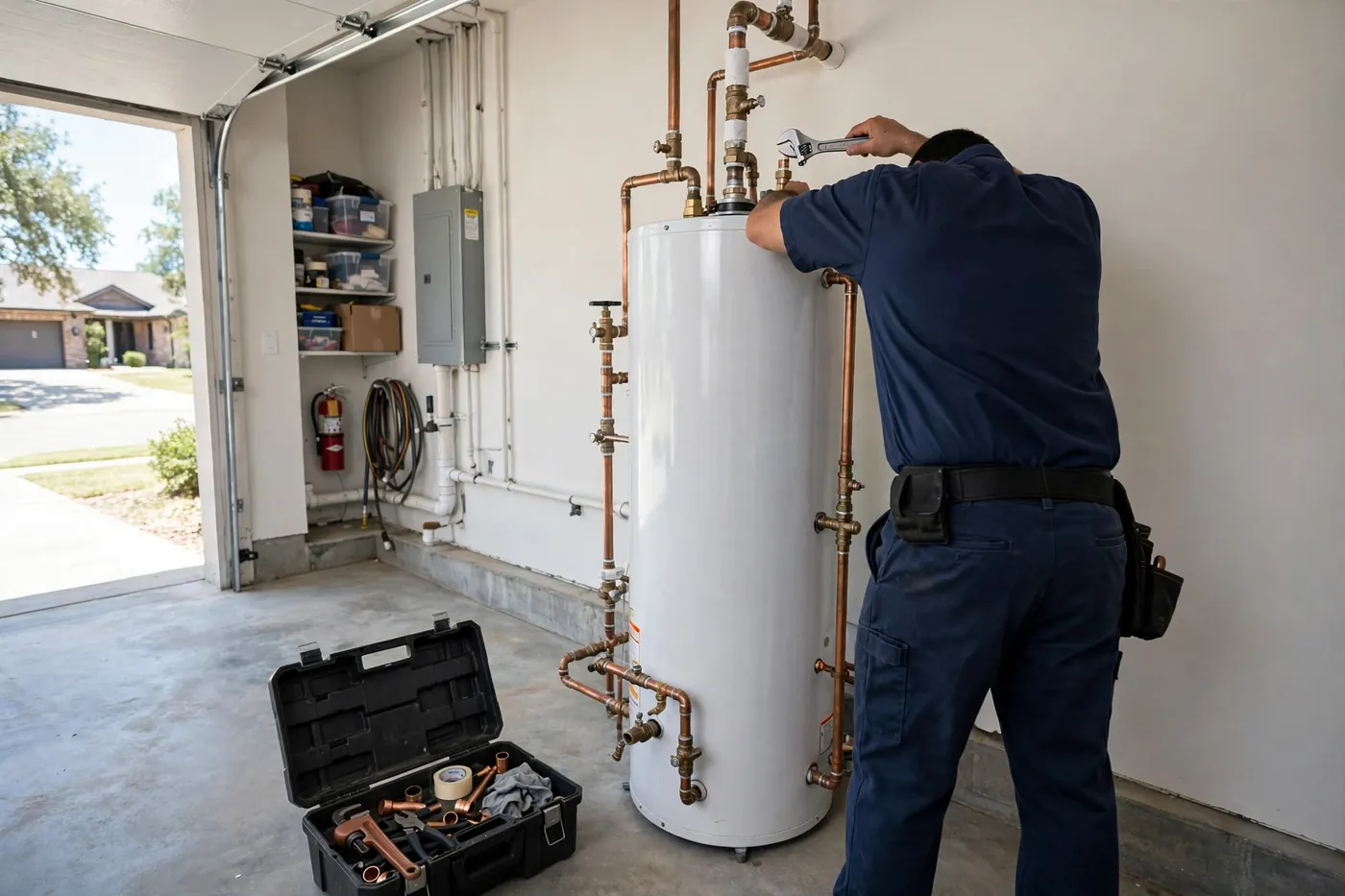
Plumber installing a new hybrid heat pump water heater tank in a Seagoville home garage
Seagoville, Texas · ZIP 75159

Hybrid Heat Pump Water Heater in Seagoville, TX

A hybrid heat pump water heater does not make heat, it moves it: it pulls warmth from the air around it and puts it into the water, using far less electricity than a standard electric tank for the same hot water. In a Seagoville garage, where the air is warm for most of the year, that is a natural fit. This page covers how hybrids work, where they belong in a Texas home, and when the upgrade from a standard electric tank makes sense.

Call (833) 382-2711 Replacing an electric tank? Ask whether a hybrid fits your garage.

Open Mon-Fri, 7am-6pm

  • Moves heat instead of making it, so it uses far less electricity than a standard tank
  • Built to last 10 to 15 years, longer than a standard electric or gas tank
  • Cools and dehumidifies the garage as it runs, a real bonus in a Texas summer
  • Heat pump efficiencyMoves heat, not makes it
  • ZIP 75159Every neighbourhood covered
  • Licensed-plumber workDone to Texas code
  • Permit handledOpenGov filing and inspection arranged

Is a hybrid heat pump water heater right for your Seagoville home? The quick answer

Call (833) 382-2711 and ask whether a hybrid fits your garage. A hybrid heat pump water heater uses far less electricity than a standard electric tank, lasts 10 to 15 years, and suits a Seagoville garage install, where warm air is available most of the year. It runs on the same 240V circuit as a standard electric tank and needs a condensate drain fitted.

A hybrid is still a tank, so Seagoville hard water, about 9.5 grains per gallon, still calls for a yearly flush and anode rod checks. Read the Seagoville hard water section and the Seagoville permit process before you book, or just call and ask.

How a hybrid works

A heat pump water heater moves heat instead of making it

A standard electric tank makes heat with elements, like a giant kettle. A hybrid works the other way: a heat pump on top of the tank pulls heat out of the surrounding air and moves it into the water, the same principle as a refrigerator in reverse. Moving heat takes far less energy than making it, which is why a hybrid uses much less electricity than a standard electric tank for the same amount of hot water. Backup electric elements are built in for heavy demand or cold conditions, so hot water is not interrupted when the heat pump alone cannot keep up.

Why Texas is a good fit for a hybrid

A heat pump works hardest when the air around it is warm, and a Seagoville garage is warm for most of the year. That is the core of the case for a hybrid in Texas: the climate gives the heat pump free heat to move for far more months than it would in a cold state. The unit also cools and dehumidifies the garage as it runs, pulling moisture out of the air as a side effect. In a Texas summer, when a garage doubles as a workshop or laundry space, that cooling is a genuine bonus rather than a drawback.

What a hybrid looks like in your garage

A hybrid looks like a standard tank with a heat pump unit mounted on top, which makes it taller and slightly wider than the tank it replaces. It runs on the same 240V circuit as a standard electric tank, and the water connections sit in the same place, so the swap is straightforward where the space allows. Two things need checking before the install: headroom and clearances around the unit, and a condensate drain, because the heat pump produces condensation as it pulls moisture from the air. The unit also makes a low fan noise while running, comparable to a quiet refrigerator, so a garage location away from bedrooms is the better choice.

Hybrid vs standard electric vs gas tank

The honest comparison is about running cost, install work and life expectancy. A hybrid costs more to buy and install than a standard electric tank, and the gap is partly offset over time by lower running costs, which is why the case is strongest where the current heater is an electric tank due for replacement anyway and the household uses a lot of hot water. Against a gas tank, a hybrid has no venting and no gas connection, but it needs the condensate drain and the air volume a gas tank does not. The table below sets out the differences plainly.

Winter in a Seagoville garage

Seagoville winters are mild enough that the heat pump does most of the work for most of the year, and the backup elements cover the coldest spells. In a hard freeze the same rules apply as for any heater in a garage or attic: pipe insulation on exposed lines, a heater blanket where the manufacturer allows it, and shutoffs everyone in the house can find. In February 2021, Winter Storm Uri held the Dallas-Fort Worth area at or below freezing for 139 consecutive hours, and freezing pipes were the top cause of property damage in the more than 500,000 insurance claims filed statewide, which is why freeze preparation belongs in every Seagoville water heater plan.

FeatureHybrid heat pumpStandard electric tankGas tank
How it heatsMoves heat from the air, plus backup elementsHeating elements in the tankGas burner under the tank
Running costLowest of the threeHighest of the threeBetween the two
Expected life10 to 15 years8 to 12 years8 to 12 years
Install needs240V circuit, air volume, condensate drain240V circuit onlyGas line and venting
Best locationGarage with space around itGarage, attic or closetGarage, attic or closet
Maintenance in hard waterYearly flush, anode rod checksYearly flush, anode rod checksYearly flush, anode rod checks
Simple by design

How a hybrid water heater install works here

There are no forms on this site to fill in. Calling is the whole process, because a two-minute conversation sorts out what a form never can: what heater you have now, where it sits, and whether a hybrid fits the space.

Call and describe the setup

Call (833) 382-2711 and say what you have now, electric tank size if you know it, and where the heater sits. A garage install is the usual fit for a hybrid, and the space around it decides the size.

Space, circuit and drain checked

Headroom and clearances are checked against the hybrid's size, the 240V circuit is checked, and a route for the condensate drain is planned. A hybrid is taller than the tank it replaces, so this check comes before the unit is chosen.

Installed, inspected, hot water back

The old heater is removed, the hybrid is installed with its condensate drain, and the work is inspected. The heat pump mode and the backup elements are both checked before the job is finished.

Placement decides everything

Where a hybrid belongs, and where it does not

A garage is the ideal spot for a hybrid in Seagoville: warm air for most of the year, space around the unit, and a straightforward route for the condensate drain. Most Seagoville homes put the water heater in the garage already, which is why the hybrid swap is usually simple here. The unit needs air volume around it to pull heat from, so a small sealed closet is a poor fit, and the clearances the manufacturer sets out have to be kept.

An attic install is possible but needs more planning: the condensate drain has to run somewhere sensible, the unit needs safe access for service, and the attic is the coldest space in the house in a freeze, which means the backup elements do more of the work in winter. A heater in a living space is a poor fit for a different reason: the unit cools the air around it and makes a low fan noise while running, which is welcome in a garage and less welcome in a hallway.

Hard water does not care that the heat source is a heat pump. A hybrid is still a tank, and Seagoville tap water at about 9.5 grains per gallon still leaves sediment on the bottom and uses up the anode rod faster than soft water would. A yearly flush and anode rod checks on schedule protect the longer life a hybrid is bought for. See water heater maintenance in Seagoville for the schedule.

Who a hybrid suits best

The strongest case is a household with an electric tank in the garage that is due for replacement, a family that uses a lot of hot water, and a garage with room around the heater. The weakest case is a small household with low hot water use, a heater in a tight closet, or a home where the gas line is already in place and a gas tank is the simpler swap. The call sorts out which one you are: describe the current heater, where it sits and how many people use the hot water, and the answer is usually clear within minutes.

Replacing an electric tank?

A hybrid runs on the same 240V circuit as a standard electric tank, so the upgrade is often a straight swap where the garage has the space and a condensate drain can be fitted. Ask on the call whether your garage fits one.

Call (833) 382-2711
Local, and only local

Hybrid water heaters across Seagoville

Hybrids are still uncommon in Seagoville, which is exactly why the upgrade is worth knowing about: no page-1 competitor in this city talks about them. The best fits are the newer subdivisions, where garages are roomy and the electric tanks are approaching replacement age, and the older core, where an electric tank replacement is already due and the garage has the space.

New subdivisions: roomy garages, electric tanks

Homes in Seagoville Farms, Edmonds Ranch, Stonehaven and Cottonwood Creek were mostly built with standard electric or gas tanks, and their garages usually have the space a hybrid needs. As those first tanks reach the end of their life, the hybrid swap is the efficiency upgrade that fits the same 240V circuit and the same water connections, with a condensate drain added.

Older core: replacements with room to upgrade

The older streets around Malloy Bridge Road, Seagoville Road and Kaufman Street carry original electric tanks now 15 to 25 years old. Where the heater sits in a garage with headroom, a replacement is the natural moment to consider a hybrid, because the install work overlaps: the old tank comes out either way, and the condensate drain is the only extra job.

  • Seagoville Farms
  • Edmonds Ranch
  • Stonehaven
  • Cottonwood Creek
  • Santorini
  • Tredway Estates
  • Malloy Bridge Road area
  • Seagoville Road area
  • Kaufman Street area
  • US-175 frontage

Every part of Seagoville in ZIP code 75159 is covered, in Dallas County and on the small eastern edge in Kaufman County. See the full breakdown on the Seagoville service area page.

See Seagoville coverage in detail →
What decides the cost

Hybrid heat pump water heater cost factors in Seagoville

There is no single price for a hybrid install, because the job changes with the home. These are the factors that decide it:

  • Tank size: a larger hybrid suits the larger households common in Seagoville and costs more to supply and fit.
  • Condensate drain: a new drain run is the main extra job over a standard electric tank swap, and its length depends on the garage layout.
  • Circuit work: a sound existing 240V circuit keeps the job simple; a circuit that needs running adds to it.
  • Space and access: a garage with headroom and clearances is straightforward; a tight or attic location takes more time.
  • Condition of the old install: seized shutoff valves, corroded fittings and missing drain pans are fixed as part of the job.
  • Permit and inspection: typically required in Seagoville, pulled by your plumber through the OpenGov portal.

A hybrid costs more to install than a standard electric tank, and the gap is partly offset over time by lower running costs, which is why the case is strongest where the current heater needs replacing anyway. Call (833) 382-2711 and describe your current heater and where it sits. See the cost factors section on the homepage for how these factors compare across all heater types.

What to have ready

Your address in 75159, the size of the current tank if you know it, where the heater sits, and roughly how much headroom and space there is around it. That is enough to say whether a hybrid fits, on a single call.

Call (833) 382-2711
Questions

Hybrid heat pump water heater in Seagoville: frequently asked questions

What is a hybrid heat pump water heater and how does it work?

A hybrid heat pump water heater pulls heat from the surrounding air and moves it into the water, instead of making heat with a burner or an element. It looks like a standard tank with a heat pump unit on top, and it keeps backup electric elements for heavy demand or cold conditions. Because moving heat takes less energy than making it, a hybrid uses much less electricity than a standard electric tank for the same hot water.

How much does a hybrid heat pump water heater cost to install in Seagoville?

The cost depends on the tank size, whether the garage or install location needs a condensate drain fitted, whether the existing 240V circuit is adequate, and the permit and inspection. A hybrid unit costs more to buy and install than a standard electric tank, and the gap is partly offset over time by lower running costs. Call (833) 382-2711 and describe your current heater and where it sits for a straight answer on what drives the cost in your home.

Is a hybrid water heater worth it in Texas?

Texas is one of the best places for a hybrid water heater, because the heat pump works hardest when the surrounding air is warm, and a Seagoville garage is warm for most of the year. The unit also cools and dehumidifies the garage as it runs, which is a real bonus in a Texas summer. The case is strongest where the heater sits in a garage, the household uses a lot of hot water, and the current heater is an electric tank that is due for replacement anyway.

Where should a hybrid water heater be installed?

A garage is the ideal spot in Seagoville: warm air for most of the year, space around the unit, and a place for the condensate drain. A hybrid needs air volume around it to pull heat from, clearances the manufacturer sets out, and a drain for the condensate it produces. It is not a good fit for a small sealed closet, and it makes a low fan noise while running, so a location away from bedrooms is better. An attic install is possible but needs the drain and access planned carefully.

How long does a hybrid heat pump water heater last?

A heat pump water heater is built to last 10 to 15 years, longer than the 8 to 12 years of a standard tank. In Seagoville hard water, about 9.5 grains per gallon, the same maintenance rules apply as for any tank: a yearly flush and an anode rod checked on schedule. Without flushing, sediment shortens the tank's life just as it does on a standard electric or gas tank.

Can a hybrid water heater replace my electric tank directly?

In most cases, yes. A hybrid runs on the same 240V circuit as a standard electric tank, and the water connections are in the same place. The differences are size, a hybrid is taller and wider than the tank it replaces, so headroom and floor space are checked first, and the condensate drain, which a standard tank does not need. Where the heater sits in a garage with room around it, the swap is straightforward.

Does a hybrid water heater work in a garage in winter?

Yes. A hybrid has backup electric elements that take over when the air is too cold for the heat pump to work efficiently, so hot water is not interrupted in a cold snap. Seagoville winters are mild enough that the heat pump does most of the work for most of the year, and the backup elements cover the coldest spells. In a hard freeze, the same pipe insulation and shutoff checks apply as for any heater in a garage or attic.

Do I need a permit for a hybrid water heater in Seagoville?

In most cases, yes. Seagoville has adopted the 2024 International Codes with city amendments and the 2023 National Electrical Code, contractors must register with the city before applying, and permits are issued through the city's OpenGov portal with inspections scheduled on 972-287-6829. Your plumber pulls the permit and arranges the inspection, and the electrical connection and condensate drain are checked as part of it.


Ask whether a hybrid fits your Seagoville garage

One call, your current heater and where it sits, and the answer is usually clear within minutes.

Call (833) 382-2711
Call (833) 382-2711
Call (833) 382-2711